


Empowering Apatani Women through Fish Value Addition in Ziro Valley, Arunachal Pradesh: Positive stride towards entrepreneurship in post-harvest fisheries
The Apatani Valley in Ziro, located in Lower Subansiri district of Arunachal Pradesh, lies in the North East region of India between the Panior and Kamla rivers at an altitude of about 1,524 m above mean sea level. The Apatani tribe, a progressive agricultural community, practices an efficient paddy-cum-fish culture system, supported by strong indigenous knowledge of land and water management. Approximately 48.38% of the agricultural land in the valley is under paddy-cum-fish cultivation. Common carp produced in this system has high local demand and is mainly sold as live fish, while surplus fish are traditionally preserved through sun drying and smoking.

With a mission to empower the Apatani Tribal community through science and technology, the ICAR–Central Institute of Fisheries Technology (ICAR-CIFT), Visakhapatnam Research Centre has organized a three-day Training-cum-Demonstration programme titled “Entrepreneurship Development of Apatani Tribes of Ziro Valley through Hygienic Fish Drying, Smoking and Value Addition” in Ziro Valley, from 13 to 15 February 2023. The programme focused on skill enhancement of Apatani women with the objective of promoting sustainable small-scale fisheries-based entrepreneurship. The participants were trained on hygienic curing and drying of fish, preparation of value-added products such as fish pickle, fish fingers, fish cutlets, burgers, marinated fish, steaks and fillets, along with modern packaging techniques including vacuum packaging and retail-friendly pouches
To strengthen field-level implementation, a Memorandum of Understanding (MoU) was signed between ICAR-CIFT and M/s Gaumco Multipurpose Co-operative Society Ltd., Ziro, that has more than 80 members, predominantly women. Under the MoU, ICAR-CIFT provided need-based technological guidance and small-scale fish processing equipment to establish a mini fish value addition unit, enabling hygienic handling and value addition of fish and fishery products.
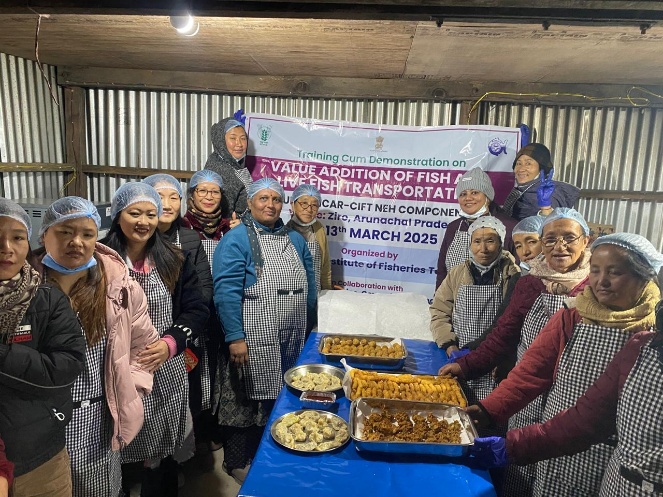
At present, 20 women members of the society are actively involved in fish value addition activities, contributing to enhanced income generation and livelihood diversification. The society has also emerged as a local training hub, conducting capacity-building programmes for other groups under NABARD-funded projects.
This initiative demonstrates how scientific training and institutional support can transform traditional practices into viable livelihood opportunities, empowering tribal women and strengthening fisheries-based entrepreneurship in the North-Eastern region.
Jesmi Debbarma1, Viji P1., Parvathy U2., Bindu J2., and B. Madhusudana Rao1
1Visakhapatnam Research Centre of ICAR-Central Institute of Fisheries Technology (ICAR-CIFT), Visakhapatnam – 530003, Andhra Pradesh
2ICAR-Central Institute of Fisheries Technology (ICAR-CIFT), Kochi-682029, Kerala
Page Last Updated on
Visitors Count :

All rights reserved © Central Institute of Fisheries Technology (CIFT)
Website Powered by Cloud Business Pages from INI Technologies Pvt Ltd, India